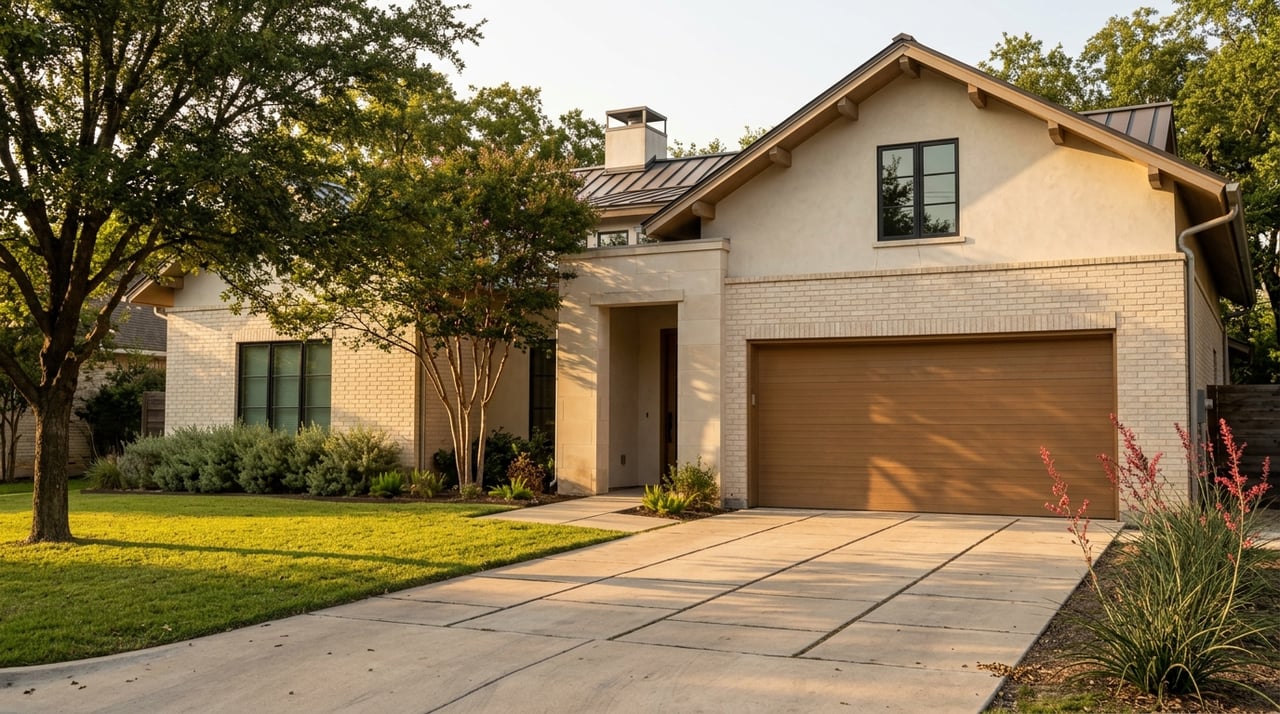
Two new-construction listings land in the same search, both around $700,000, both zoned to Frisco ISD, both roughly the same square footage. A buyer runs the numbers on each and the estimated monthly payment comes back different by a few hundred dollars. Same builder tier, same price, same city. Different payment.
The gap usually isn't insurance or HOA dues. It's whether the lot sits inside a Municipal Utility District, a Public Improvement District, both, or neither. That distinction never shows up as a search filter on any listing site, and it's the piece of the math that decides what a home actually costs to hold for the next twenty years, not just what it costs to close on.
Two different tools, two different shapes over time
A MUD is a taxing district created to fund the water, sewer, drainage, and road infrastructure a new development needs before a city extends its own utilities to the area. Homeowners inside the district pay an additional property tax, calculated the same way as any other ad valorem tax, applied against the appraised value of the home. That tax pays down bonds the district issued to build the infrastructure in the first place.
A PID works differently. A city creates it to finance a defined slate of improvements, often things like parks, streetscapes, entryway features, or enhanced landscaping within a specific community. Instead of a value-based tax, the PID charges a special assessment, often set as a fixed schedule tied to the lot rather than the home's current worth. The City of Frisco's own PID page is direct about the split: the PID fee paid to a homeowners association covers ongoing maintenance of the amenities, while the separate PID assessment repays the bonds that built them in the first place.
Here's the part that catches most buyers off guard. A MUD tax, because it's tied to appraised value and repays a bond, tends to trend downward as a district matures. More rooftops means a larger tax base spread across the same debt, and as bonds get retired the rate can ease. A PID assessment doesn't work that way. It was set at the community's formation according to a fixed assessment plan, sometimes a flat dollar figure per lot, sometimes a schedule that escalates on a set timeline, and it rarely moves in the buyer's favor. It rides with the property, not the price. Whoever owns the lot when the district's bonds are still outstanding owes the remaining balance, whether that's the original buyer or the next one at resale.
Buyers tend to ask hard questions about the MUD line because it's the number printed clearly on the tax certificate. The PID line, smaller and less familiar, gets less scrutiny. Over a twenty to forty year horizon, that's backward.
Where this actually plays out on the ground in Frisco
Not every new-construction community in Frisco carries the same tax structure, and the differences are large enough to change which house makes financial sense.
Some communities market themselves specifically around avoiding a MUD altogether by folding infrastructure costs into the lot price upfront instead of financing them through a district. The Grove, a 735-acre master-planned community developed by Newland at the point where Frisco, Plano, Allen, and McKinney meet, is one of the communities built this way, with builders including Highland Homes, American Legend Homes, Southgate Homes, and Trophy Signature Homes active there. Certain sections of Fields and Lexington follow a similar approach. Communities structured this way tend to land with a total effective tax rate somewhere in the high 1.6% to 1.8% range.
Other Frisco communities, including Mustang Lakes and Lilyana, were financed with the district model instead, carrying PID assessments or MUD taxes as part of how their infrastructure got built. A brand-new community sitting inside a heavier MUD district can push a total tax rate past 2.2%, sometimes above 2.5%, once every layer is stacked.
| Structure | Example communities | Approximate total tax rate |
|---|---|---|
| No MUD (cost built into lot price) | The Grove; parts of Fields and Lexington | ~1.69% to 1.8% |
| Standard Frisco ISD baseline, Collin County side, no district overlay | Baseline comparison | ~1.675% (tax year 2025) |
| Standard Frisco ISD baseline, Denton County side, no district overlay | Baseline comparison | ~1.631% (tax year 2025) |
| MUD or PID district present | Mustang Lakes; Lilyana; other master-planned districts | 2.2% or higher |
The rates above are approximate and change year to year as bonds get retired or new debt gets issued, which is exactly why pulling the current tax statement on a specific address matters more than trusting a community-wide average.
The baseline itself just moved for the first time since 2017
None of this happens in isolation from the city's own rate, and that rate is no longer static. Frisco held its property tax rate flat at $0.425517 per $100 of assessed value for fiscal year 2026, the same figure approved the year before, while raising the homestead exemption from 15% to 20%, the maximum allowed under Texas law. That exemption increase took effect on bills starting this January, saving the average Frisco homeowner about $120 a year on the city portion of their tax bill.
That stability didn't carry into the next budget cycle. On August 10, 2026, the Frisco City Council approved a maximum tax rate of $0.441289 per $100 of valuation for fiscal year 2026-27, according to Community Impact's coverage of the meeting, marking the city's first proposed rate increase since 2017. The first public hearing was held August 18, a second is set for September 1, and the council's final vote is scheduled for September 15 ahead of the new rate taking effect in October. City Manager Wes Pierson described the shift as reflecting a growing responsibility to reinvest in the roads, parks, equipment, and people that have made Frisco successful.
That matters for anyone comparing communities right now. The city-only baseline that MUD and PID rates get added on top of is itself shifting for the first time in nearly a decade. A buyer running the math on a home today should treat this fall's public hearings as worth watching, not just the district-level line items.
Checking before an offer, not after closing
The good news is that none of this is hidden if a buyer knows where to look before writing an offer rather than after.
- Pull the parcel record from the Collin County or Denton County Appraisal District, whichever applies, to see the full list of taxing entities attached to the address.
- Request the actual current-year tax statement from the county tax office for that specific parcel. Community-wide averages don't always reflect a particular phase or section.
- Check the title commitment once a contract is in place. Recorded PID assessment liens and MUD obligations show up there in writing.
- Ask the district directly, if one applies, for its current debt service schedule. That schedule shows whether the assessment is fixed, declining, or scheduled to change on a set timeline.
Lenders typically fold both property taxes and mandatory PID or MUD assessments into the monthly mortgage payment, whether they're billed together on the county tax statement or separately by the district. That's exactly why the number needs to be confirmed before an offer goes in, not discovered on the first loan estimate.
A few questions that come up often
Does a MUD or PID line automatically show up in an online mortgage calculator? Rarely. Most calculators default to a generic property tax estimate and miss district assessments entirely, which is part of why two homes at the same price can produce very different payment quotes once a real loan estimate comes back.
Will a PID assessment ever go away? Yes, once the bonds that funded the district's improvements are fully repaid, typically over a period of 20 to 40 years depending on the formation documents. Until then, it transfers with the property to each new owner.
Does a home in a MUD or PID make it a worse investment? Not inherently. These districts are how a large share of Frisco's newer infrastructure got built at all. The point isn't to avoid them, it's to know the number going in and compare it honestly against a home that doesn't carry one.
If you're comparing new-construction communities in Frisco and want someone to pull the actual tax certificate before you write an offer, rather than after, Everett Shell & Associate Realty has spent years reading these numbers for buyers who'd rather understand the full payment now than be surprised by it later. Book a consultation and bring your shortlist. We'll walk through what each address actually carries, line by line.