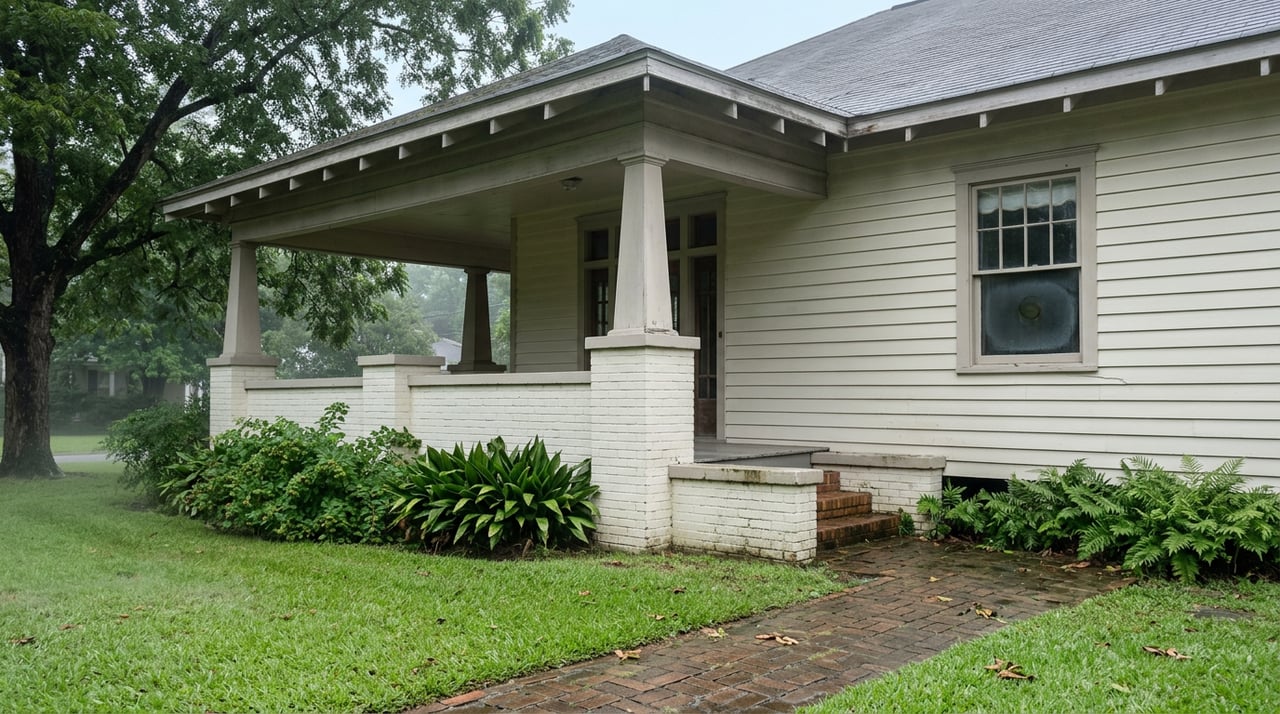
If a listing agent tells you a hundred-year-old Munger Place house had its foundation releveled two years ago, is that good news or bad news?
Everywhere else in the country, the instinct is to treat a disclosed foundation repair as a mark against the house. In Munger Place, Swiss Avenue, Junius Heights, and the rest of Old East Dallas, that instinct gets the diagnosis backward. On a hundred-year-old pier-and-beam house sitting on Blackland Prairie clay, some history of leveling isn't the anomaly. It's closer to a maintenance record. What should actually make a buyer slow down is the disclosure form that comes back clean on a house this age, because clean usually means one of two things: either the seller genuinely never noticed anything in ninety, seventy, or forty years of expansive clay doing what it does, or nobody looked closely enough to notice.
What the Disclosure Form Actually Promises You
Texas Property Code Section 5.008 requires most residential sellers to complete a written disclosure covering the condition of the property as of the date they sign it. That single detail matters more than buyers usually give it credit for. A seller's disclosure is a snapshot of what the owner knows on signing day, not a warranty and not an inspection. It tells you what someone remembers or chooses to write down. It does not tell you what an engineer would find in the crawl space.
For a pier-and-beam house built before 1978, that gap widens. Federal law under 42 USC 4852d layers a separate lead-based paint disclosure on top of the state form for any home built before that year, which covers essentially the entire original stock of Munger Place and Swiss Avenue. Two forms, two different signatures, and neither one is an inspection report. That's the reason a structural evaluation during the option period matters more here than the paperwork itself.
Why the Symptoms Hide for Years First
Pier-and-beam problems rarely announce themselves. A squeaky floorboard gets blamed on the dog. A sticky door gets a quick plane and a coat of paint, and the underlying cause keeps working underneath the fix. That pattern, common across older Dallas-Fort Worth homes according to the foundation contractors who service them, is why a house can look fine for a decade and then show sudden, visible movement after one wet spring.
An estimated 40 percent of older Dallas-Fort Worth homes still sit on pier-and-beam foundations rather than modern slabs, a share drawn heavily from the same pre-1960s neighborhoods that ring downtown, Old East Dallas among them. That's not a defect specific to any one address. It's the standard construction method of the era, the same way rotary phones were standard once. The question worth asking isn't whether a pier-and-beam house has ever moved. It's whether anyone caught the movement early enough to do something cheap about it, or let it run until the fix got expensive.
The Weather Pattern Underneath Every Old Slab and Pier
The mechanism is simple and it never actually stops. North Texas gets roughly 37 to 40 inches of rain a year, but the water doesn't arrive evenly. It comes in intense bursts during spring storms from March through June, again in a wet stretch in fall, with long dry periods in between. That soak-and-shrink rhythm is exactly what expansive clay responds to hardest, swelling on the wet end of the cycle and contracting hard through a dry August.
Every foundation in the city rides that same cycle. The only real variable a homeowner controls is where the roof water lands when it finally comes down, which is why gutter discharge points, yard grading, and downspout extensions show up again and again in inspection notes for older East Dallas properties. None of that is dramatic. All of it is why a house that looked stable in June can show a new hairline crack by October.
Reading the District by Era
The specific foundation question changes depending on which pocket of Old East Dallas a listing sits in, because the construction era changes street by street.
| Era and style | Where you'll find it | Typical foundation | What to ask about |
|---|---|---|---|
| 1900s-1920s Prairie, Craftsman, American Foursquare | Munger Place, Swiss Avenue, Junius Heights, Peak's Suburban Addition | Pier and beam, historically brick or concrete block piers | Whether original piers were replaced with steel or poured concrete, and whether a transferable warranty came with the work |
| 1920s-1930s Tudor and transitional Prairie | The M Streets | Pier and beam, occasionally a later slab addition | Where a slab addition meets the original pier-and-beam section, since that seam is where differential movement tends to show first |
| 1940s-1960s ranch | Parts of East Dallas and Lake Highlands | Mixed, transition-era construction | Which foundation system supports which wing of the house |
| Post-1965 construction and infill | Newer builds and teardown replacements citywide | Slab, often post-tension | A lot-specific geotechnical report rather than a generic neighborhood assumption |
The takeaway isn't that any one era is worse. It's that the right question depends on knowing which era you're standing in, and a buyer who asks the M Streets question about a Munger Place house, or vice versa, is asking about the wrong seam entirely.
The Line Item That Actually Matters
Buried in the disclosure form is a detail most buyers skim past: if the seller has had foundation work done, they're required to name the company that did it and state whether a transferable warranty exists. That single line does more work than the rest of the foundation section combined. A named repair company with a transferable warranty means a buyer inherits both the fix and the accountability behind it. A vague reference to "some leveling a while back" with no company name and no warranty means the buyer inherits the repair with none of the protection.
This is also where a listing can turn a repair into a selling point rather than a liability. A D Magazine feature on a renovated Prairie-style home on Worth Street in Munger Place quoted listing agent Beth Rider saying simply that "the foundation has been bolstered" as part of the home's full renovation. In a market where the housing stock is a century old, that's not a confession. It's a credential.
What Repair Actually Costs Here
The dollar figures matter less as a warning and more as context for negotiation. Foundation repair across Texas generally falls into three bands: minor leveling runs $1,500 to $5,000, more involved pier work moves past $20,000, and severe cases needing extensive underpinning can reach $40,000 or more. None of those numbers should be a dealbreaker on their own. They're a starting point for a pricing conversation, the same way a roof replacement estimate is.
Where Preservation Rules Actually Help You
Exterior changes in a designated historic district typically require a Certificate of Appropriateness before work begins, which sounds like an obstacle for anything structural. Foundation and drainage work usually happens below grade or behind existing lines, so it rarely triggers that review the way a new porch or window change would. More useful for buyers to know: in Lakewood's historic-district framework, foundation repair is one of the rehabilitation costs that can qualify for local tax incentives, the same program that covers roofing, plumbing, and electrical upgrades tied to preserving a historic property. A buyer weighing a repair estimate against a hundred-year-old house isn't necessarily weighing it alone.
The Swiss Avenue Historic District, established in 1905 and designated in 1973 as the first historic district in the City of Dallas, still centers on the Aldredge House, its landmark museum property, and the same preservation framework extends informally to how neighbors think about maintaining the housing stock next door. Munger Place, adjacent and overlapping, joined the National Register of Historic Places in 1977 and became a Dallas Landmark District in 1988. The Munger Place Historic District Association still hosts porch parties and wine walks for residents, evidence that the preservation impulse here is social as much as regulatory.
The Signal Worth Trusting
None of this means every disclosed repair is good news and every clean form is bad news. It means the usual shortcut, treat any repair history as a warning sign, doesn't hold up against how these particular houses actually age. On a century-old pier-and-beam property riding the same clay cycle every summer and fall, the informative signal is specificity: a named contractor, a transferable warranty, an engineer's letter on file. The form that should slow a buyer down is the one that says nothing happened in a hundred years, on a soil type that guarantees something eventually will.
FAQ
Does a disclosed foundation repair lower resale value in Munger Place or Swiss Avenue? Not inherently. A documented repair with a named contractor and a transferable warranty tends to read as maintenance, not damage, particularly in a housing stock where pier-and-beam movement is close to universal over a century of ownership.
What if the seller marks the foundation question "unknown"? Unknown is a legitimate answer when a seller genuinely hasn't had the foundation evaluated, but it's also a reason to lean harder on your own structural engineer during the option period rather than relying on the form to fill that gap.
Is pier and beam automatically riskier than a slab foundation? Not automatically. Each system responds differently to the same clay cycle, and a well-maintained pier-and-beam house with a documented repair history can be a more predictable purchase than a slab house with no inspection record at all.
Foundation questions in a hundred-year-old East Dallas house are rarely simple, and the right answer usually depends on which block, which era, and which repair history you're looking at. If you're weighing a purchase or a listing in Munger Place, Swiss Avenue, Lakewood, or anywhere else in Old East Dallas, Everett Shell & Associate Realty can walk through the disclosure line by line before you write an offer. Book a Consultation to get a clear read on what a specific property's history actually tells you.